1. Technological Innovation: An Engineering Balance of Quietness and Performance
Exoskeleton Structure and Material Revolution
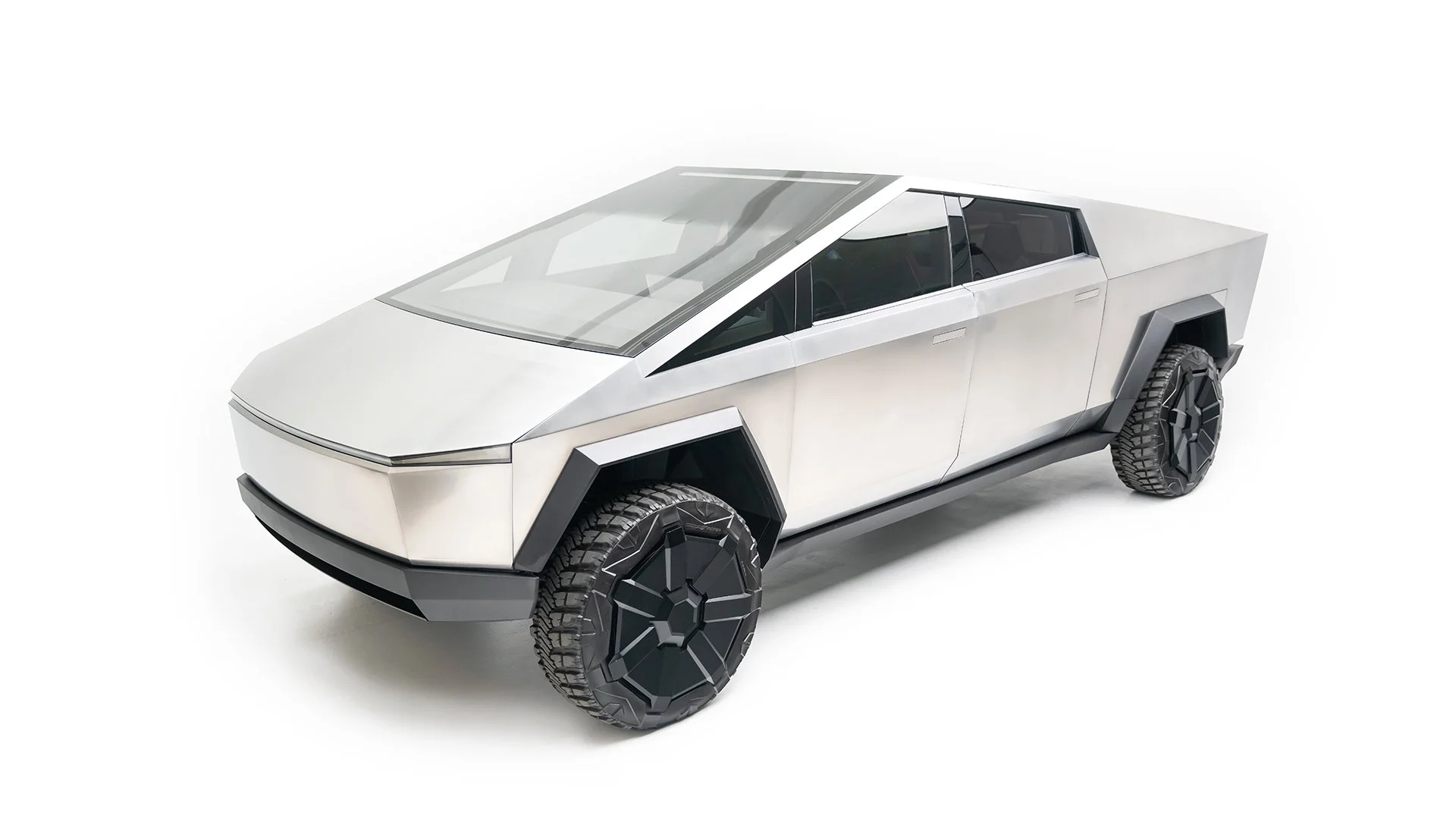
The Cybertruck utilizes a 30X cold-rolled stainless steel exoskeleton, the same material used in SpaceX's Starship. Its 3mm-thick body is not only bulletproof (capable of withstanding 9mm rounds), but its rigid structure also significantly reduces resonant noise during driving. A hidden air flap design with a nano-hydrophobic coating reduces the drag coefficient to 0.34 at high speeds while also reducing wind noise generated by wheel arch turbulence.
Quiet Optimization of the Electric Drive System
The three-motor version (Cyberbeast) uses a rotor groove design and skewed-slot permanent magnet motors to reduce high-frequency electromagnetic noise. The 48V electrical architecture reduces wiring interference, and the adaptive air suspension (305mm travel) effectively filters road vibrations. Third-party measurements show that cabin noise levels in urban driving conditions are below 62 decibels, approaching luxury car levels.
Acoustic Glass and Active Noise Cancellation
The entire vehicle is equipped with multi-layer armored glass, which is not only impact-resistant, but also features a sandwich structure that absorbs 30% of external noise. Tesla's unconfirmed but suspected active noise control system uses a microphone array to cancel motor noise in real time, creating "library-level" quietness.
II. Market Positioning: From Geek Toy to Practical Tool
Price and Audience Evolution
Although the advertised $40,000 starting price of the first generation vehicle failed to materialize (the 2025 all-wheel drive version starts at $85,000), the Cybertruck's "dynamic sizing strategy" (reducing to 1.8 meters during transport and returning to 1.93 meters during use) circumvents tariff barriers and establishes a differentiated position in the North American premium pickup truck market. Its user profile has expanded from early tech enthusiasts to building owners and outdoor adventurers.
Competitive Barrier of Quiet Performance
Compared to competitors, the Rivian R1T relies on a traditional aluminum body, resulting in high-speed wind noise reaching 73 decibels. The Cybertruck's stainless steel unibody construction, on the other hand, outperforms comparable electric pickup trucks by 7-10 decibels at 80 mph. This "powerful yet quiet" quality has become one of its core selling points.
Production Capacity and Delivery Challenges
Global sales in Q2 2025 were only 4,306 units, with the production bottleneck primarily due to the complexity of the stainless steel stamping process. The Texas plant's projected annual production capacity of 250,000 units has not yet been achieved, but Musk emphasized that the Cybertruck is a "long-term product" and that technological advancement takes precedence over short-term sales.
III. User Experience: A Practical Expression of Futurism
Scenario-Specific Quiet Design
In off-road mode, the partially open air dampers balance heat dissipation and dust control while maintaining low cabin noise. The composite floor of the cargo box reduces cargo impact noise, and when used in "bed mode," it transforms into a silent mobile campsite.
Controversy and Improvements
Early users complained about A-pillar wind noise (measured at 73 decibels). Tesla temporarily sealed the seams with tape and optimized the body assembly process in subsequent batches. Industry experts point out that manufacturing tolerance issues caused by the radical design remain a potential shortcoming in quiet performance.
Cultural Symbolic Value
The Cybertruck's angular design contrasts sharply with its "Silent Thunder" designation, symbolizing both the end of the roar of traditional machinery due to electrification and the invisible penetration of technological power—as its slogan puts it: "Thundering, yet silent."
Conclusion
The Cybertruck's "Silent Thunder" designation isn't simply a marketing jargon; it represents Tesla's new interpretation of the electric pickup truck: achieving a symbiosis of power and silence through the fusion of materials science, power electronics, and acoustic engineering. Despite facing production capacity and pricing challenges, its technological path has set a benchmark for the industry, proving that electrification can not only inherit the capabilities of fuel-powered vehicles but also reshape people's perception of "power."