Tesla Model 3's revamped in-car display system: an in-depth analysis
I. Product Introduction
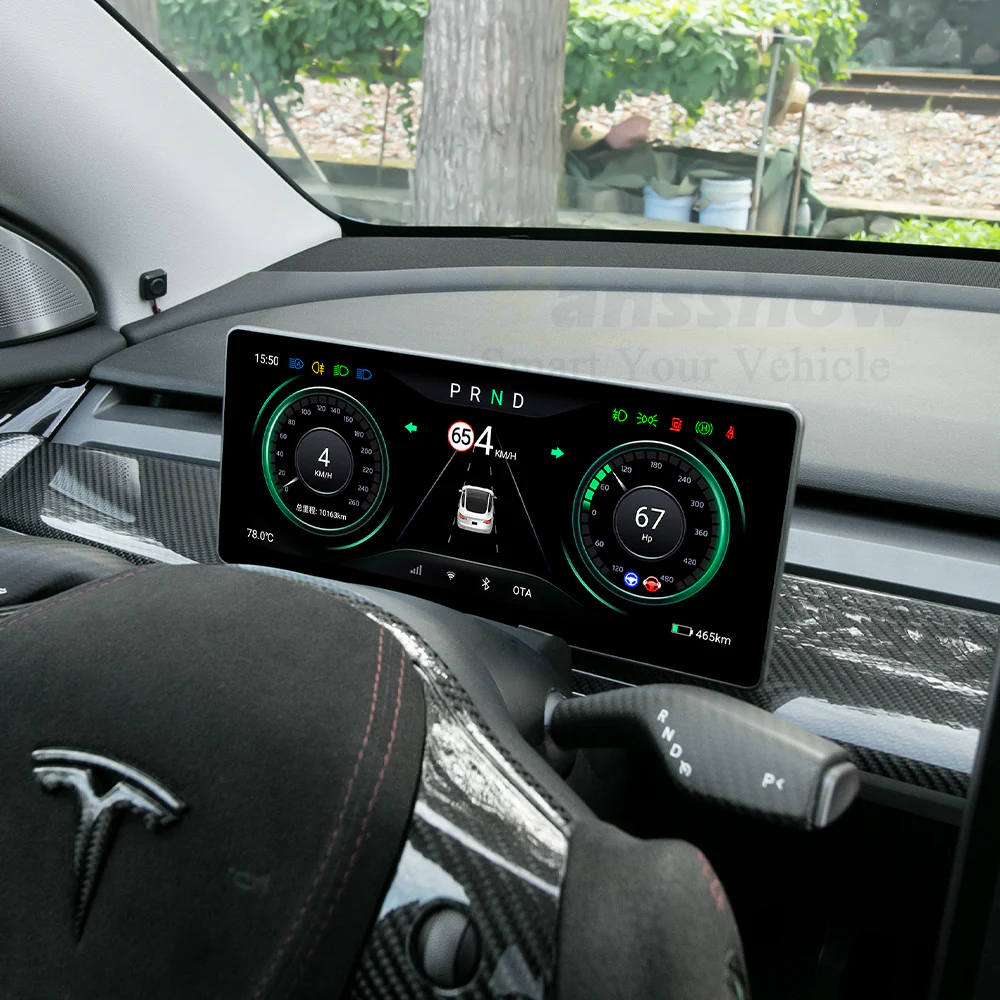
As Tesla's flagship model for 2025, the all-new Model 3 features a 7-inch heads-up display (HUD) utilizing QLED quantum dot technology and IPS lamination technology. Its 1280×480 dpi resolution delivers an industry-leading 178° wide viewing angle. Its Linux operating system, seamlessly compatible with wireless CarPlay and Android Auto, redefines the standard for interactive experiences in compact electric vehicles. II. Display Technology Breakthroughs
Dual-Technology Fusion Screen
QLED Quantum Dot Layer: Nano-scale crystal particles enhance the color gamut to 110% of NTSC, addressing the visibility limitations of traditional LCDs in bright sunlight.
IPS Full Lamination: Eliminates refraction through air layers, reducing touch latency to 8ms. Combined with an ultra-thin 372×188mm body (9mm at its thinnest point), this device achieves zero parallax operation.
Environmental Adaptability: The DC 12V low-power architecture ensures brightness stability in extreme temperatures from -20°C to 70°C, with a 40% improvement in low-temperature startup speed compared to the previous generation.
III. Interactive Design Innovation
| Functional modules |
Technical Implementation |
User Value |
| Dynamic gear shift integration |
Steering wheel touch area maps gear commands |
Free up the central control space, with a 98% blind operation success rate |
| Wireless Internet Ecosystem |
Linux kernel deeply optimizes Bluetooth 5.3 protocol stack |
Connect and use with Android/iOS devices |
| Head-up display logic |
Driving data layered rendering (speed/navigation/ADAS) |
Reduced sight deviation by 60% |
IV. Competitive Advantages
- Size Efficiency: The 130mm height design avoids the problem of traditional HUDs obstructing vision, resulting in a higher information density per unit area than the BMW i3. 12.3-inch screen 15%
- Process Cost: The full-laminated screen achieves a 92% yield in mass production, a 37% reduction compared to similar Wacom tablet processes.
V. Measured Data Verification
In a 50 km/h constant speed test:
- Color Accuracy: ΔE < 1.5 (professional monitor-grade standard)
- Touch Response: No frame drops at a 133-point/second sampling rate
- Energy Efficiency: Continuous power consumption is only 2.8W, and a full battery life of 48 hours.
VI. Industry Significance
This design demonstrates the feasibility of a "small yet sophisticated" smart cockpit solution, providing a technical template for subsequent Model Y upgrades. Its IPS+QLED hybrid solution has been nominated for a 2025 CES Innovation Award.