Introduction
On October 9, 2025, BYD's 14 millionth new energy vehicle (NEV) officially rolled off the production line at its Camacari plant in Brazil's Bahia state, with President Luiz Inácio Lula da Silva becoming the owner of this milestone vehicle. The Song Pro COP30 special edition, handed over by BYD Chairman Wang Chuanfu, symbolizes not only the automaker's global leadership but also deepened China-Brazil cooperation in green technology. As the first NEV manufacturer worldwide to reach this milestone, BYD's achievement reflects its accelerated globalization and localized strategy in key markets.
I. A Milestone Born from "BYD Speed"
The Camacari plant, where the historic roll-off occurred, embodies remarkable efficiency—completed in just 15 months from groundbreaking in March 2024 to first production in July 2025 . With a total investment of 7.1 billion yuan and covering 4.68 million square meters, this facility operates at an initial annual capacity of 150,000 units, set to expand to 300,000 . It stands as BYD’s largest overseas passenger vehicle base, serving Brazil and neighboring South American markets.
This speed translates to market responsiveness: previously, importing vehicles from China took 45 days, but local production cuts delivery to 10 days while tripling inventory turnover . The plant already employs over 1,000 workers—70% local—and will create 20,000 direct and indirect jobs long-term . Just three months after its first production run, it achieved the 14 millionth unit milestone, showcasing integrated manufacturing prowess.
II. Localization: Technology Adaptation for Brazilian Demands
The Song Pro COP30 special edition embodies BYD’s market-centric innovation. Tailored to Brazil’s energy structure, it features super flexible hybrid technology compatible with ethanol fuel , while integrating CTB (Cell to Body) technology that boosts battery energy density by 15% . This engineering addresses local needs—ethanol’s widespread availability and consumers’ range anxiety.
Supply chain localization deepens this adaptation. Facing a scarcity of NEV components in Brazil, BYD formed a R&D alliance with 12 local enterprises, upgrading traditional factories into new energy suppliers . One Injection Molding Factory underwent 7 mold iterations to produce door trim, raising localization rate from 30% to 85% . Combined with lithium mining layout and battery production plans, this creates a "lithium-battery-vehicle" local loop, cutting supply chain costs by 22% .
III. Market Leadership Backed by Data
BYD’s milestone coincides with dominant market position. From 260 units sold in 2021, its Brazilian sales surged to 76,000 in 2024—a 328% year-on-year growth . In January-May 2025, it captured 92.16% of the pure electric market and 35.8% of the plug-in hybrid segment , ranking fourth in overall national sales.
Policy alignment fuels this growth. Brazil’s 0% import tariff for NEVs (valid until 2025) and 2030 target of 30% NEV penetration align with BYD’s strategy . When import duties rose to 25% recently, BYD’s local production already reduced imported models to below 10% , insulating it from trade barriers.
IV. Beyond Cars: A Symbol of Sino-Brazilian Cooperation
The ceremony highlighted strategic partnership. Lula praised the plant for "restoring dignity to Camacari people" and noted it represents tangible China-Brazil collaboration —China has been Brazil’s top trading partner for 15 years. Days earlier, the road outside the plant was renamed "BYD Road," joining U.S. and Thai counterparts as global testaments to its influence .
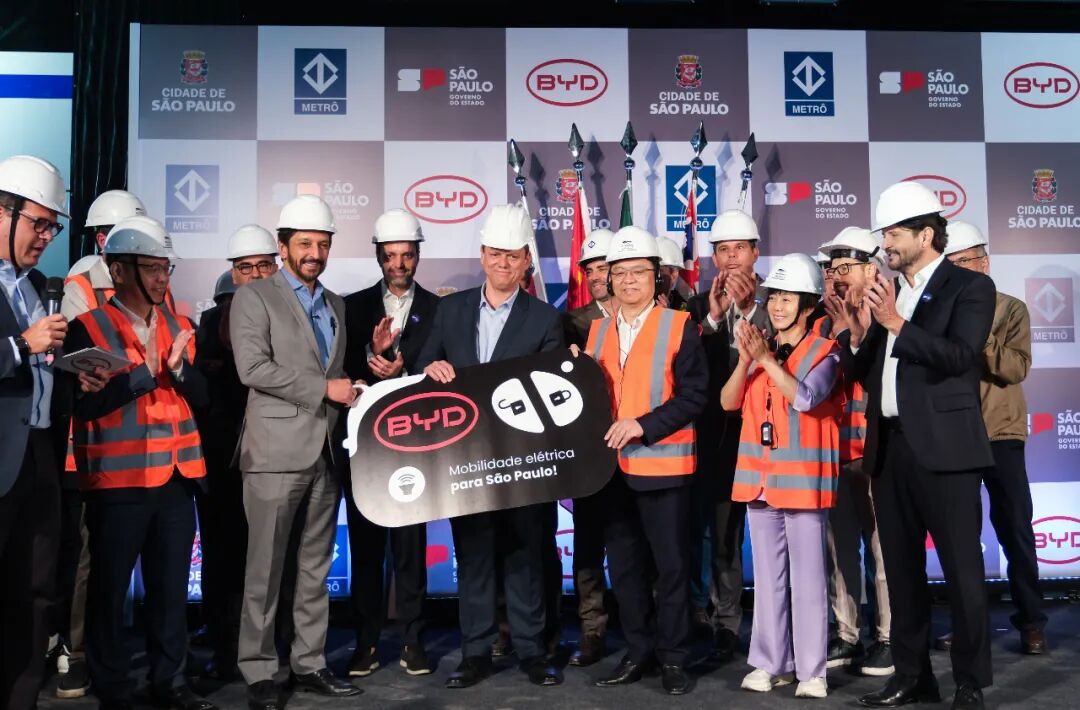
Wang Chuanfu announced 30 custom NEVs for November’s COP30 climate summit in Belém, to be donated to schools post-event . This complements BYD’s other local projects: a 6.7km SkyRail line in São Paulo (opening 2026) and 22m electric buses with 350km range, cutting operational costs by 70% vs. diesel .
Conclusion
BYD’s 14 millionth unit milestone is more than a production achievement—it demonstrates how "technology + localization" drives global NEV adoption. In Brazil, its 11-year journey from electric buses to market leader offers a blueprint for cross-border green cooperation. As Lula noted, this glory belongs to both nations , marking a new era of sustainable partnership.