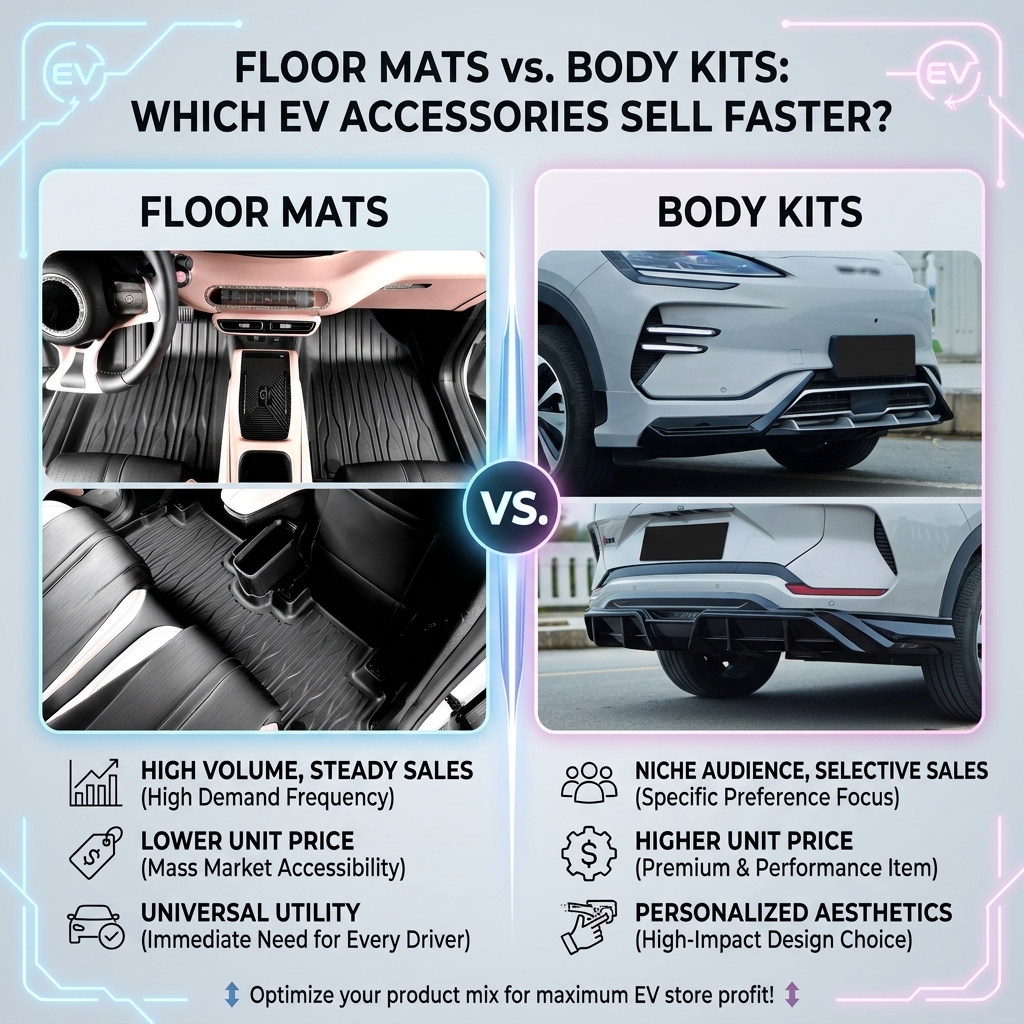
For EV accessory retailers, choosing the right products is not simply a question of product popularity. It is also a question of purchase frequency, installation difficulty, shipping cost, return risk, and the type of customer a product attracts.
Floor mats and body kits represent two very different opportunities.
Floor mats are practical interior products purchased by a broad range of EV owners. Body kits are appearance-focused upgrades that appeal more strongly to enthusiasts, customization shops, and customers willing to invest in a more substantial modification.
So, which one sells faster?
For most retailers, floor mats usually move faster. Body kits can deliver a higher order value, but they normally require more product consultation, more careful fitment confirmation, and professional installation.
Floor Mats Solve an Immediate Problem
An EV owner does not need to be interested in vehicle modification to buy a set of floor mats. The product addresses everyday concerns that are easy to understand:
- Mud and water entering the cabin
- Stains caused by food and drinks
- Wear on the original carpet
- Difficult cleaning during rainy or winter seasons
- Poor protection around the footwell and rear seats
This gives floor mats a broad market. They are relevant to private car owners, families, ride-hailing drivers, fleet operators, and commercial users.
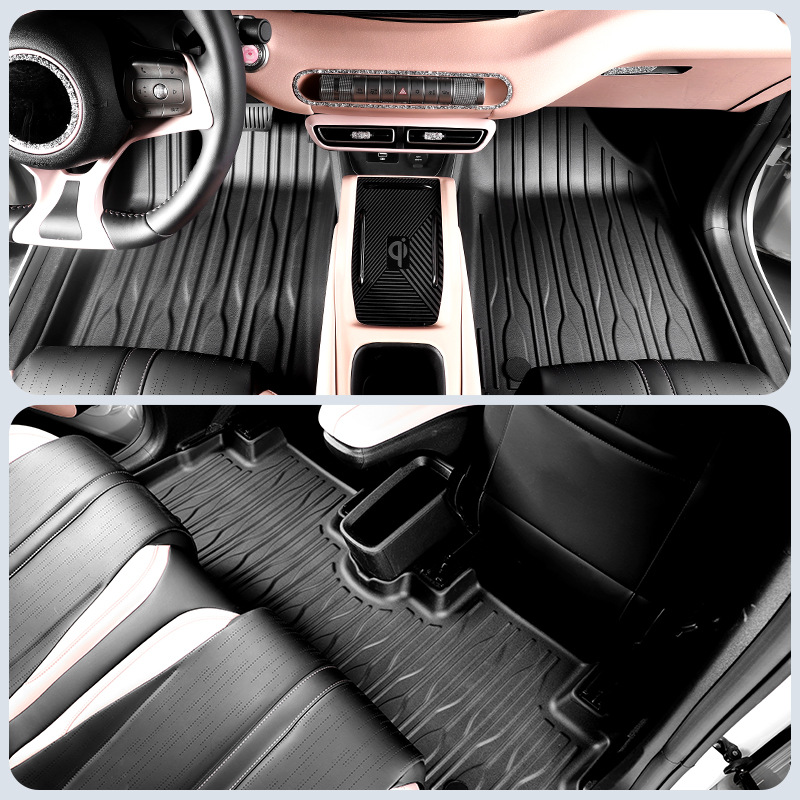
The buying decision is also relatively simple. Customers usually want to know whether the mats fit their vehicle, whether they are waterproof, how easy they are to clean, and whether they interfere with the pedals or original floor anchors.
When these questions are answered clearly, the customer can often complete the purchase without speaking to an installer.
Vehicle-Specific Fitment Is the Main Selling Point
Generic mats are widely available, but they often leave gaps around the edges or move during use. For EVs, a precise fit is particularly important because different models may have different floor shapes, seat rails, center-console layouts, and anchor positions.
A good EV floor mat should be developed around the exact vehicle configuration, including:
- Vehicle brand and model
- Model year
- Seat configuration
- Left-hand or right-hand drive
- Front and rear floor shape
- Original fixing points
- Center tunnel and seat rail clearance
This is why retailers should avoid listing a product simply as “fits Tesla” or “fits BYD.” A more useful product listing identifies the exact model and applicable year range.
For distributors, accurate fitment information reduces unnecessary returns and gives sales teams a clearer way to recommend the correct product.
Why Floor Mats Are Usually Faster-Moving Products
Floor mats have several characteristics that support faster sales.
Lower purchase barrier
Compared with a complete body kit, a set of floor mats usually requires a smaller budget. Customers are less likely to delay the purchase or compare multiple suppliers for several weeks.
Simple installation
Most vehicle-specific floor mats can be installed by the customer. No painting, drilling, cutting, or workshop appointment is normally required.
Wider customer base
Floor mats are suitable for almost every EV owner, while body kits appeal mainly to customers interested in styling or customization.
Easier online sales
The value of a floor mat can be demonstrated through clear product images, installation photos, material descriptions, and vehicle compatibility information. This makes the category suitable for e-commerce, marketplaces, distributor catalogues, and social media promotion.
Lower shipping complexity
Floor mats are easier to package than large exterior components. They are also less vulnerable to shipping damage when properly rolled, folded, or packed in shaped cartons.
For these reasons, floor mats are often a sensible starting category for a retailer building an EV accessory product line.
Body Kits Attract a Different Type of Buyer
Body kits are not competing with floor mats on the same basis. They are designed to change the appearance and character of a vehicle.
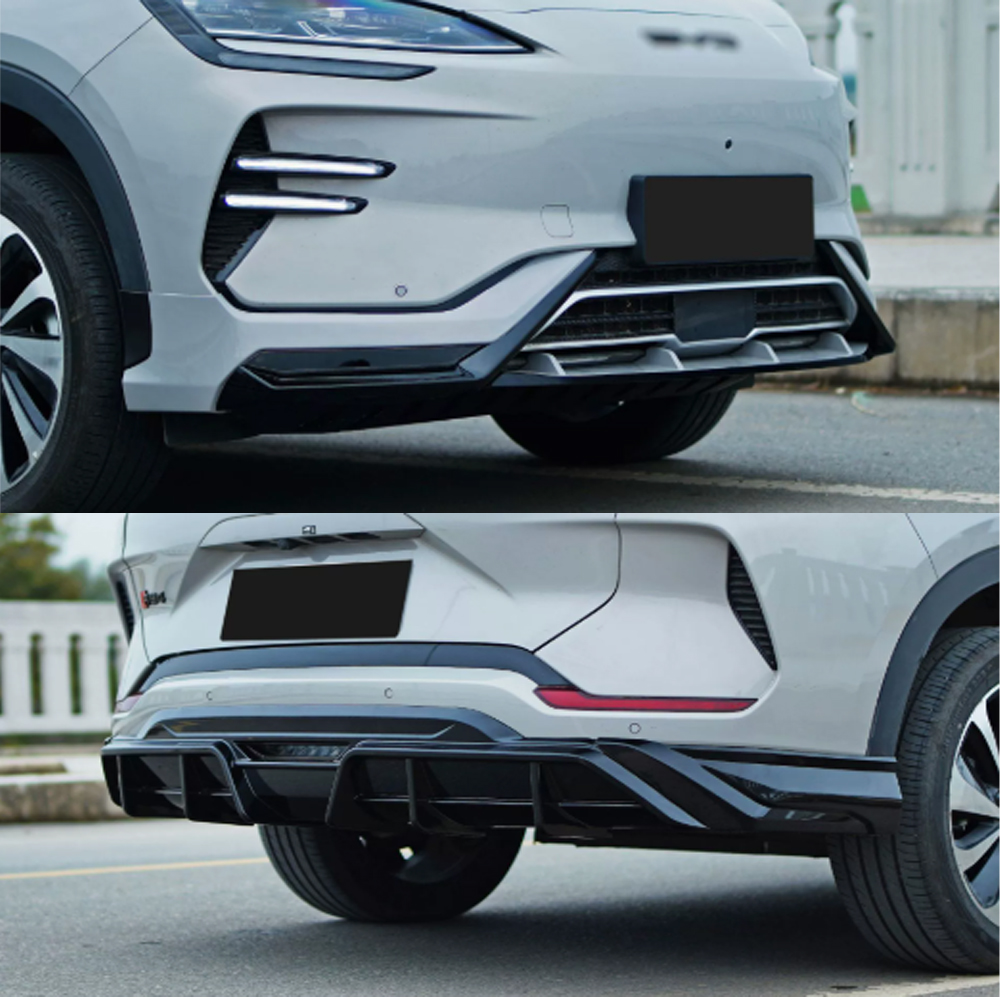
Depending on the design, a body kit may include:
- Front lip
- Front bumper extension
- Side skirts
- Rear diffuser
- Rear spoiler
- Fender extensions
- Side steps
- Complete exterior styling packages
The strongest buyers are usually EV enthusiasts, tuning customers, customization workshops, vehicle dealers, and owners who want their vehicle to look different from the standard factory version.
This market can be profitable, but the customer journey is longer. Buyers often want to compare designs, materials, installation photos, paint requirements, and the final appearance on the actual vehicle before placing an order.
Body Kits Require More Fitment and Installation Support
A body kit is not just a larger accessory. It is a product that interacts with the vehicle’s exterior structure.
Before purchasing, customers may need to confirm:
- Exact model and model year
- Trim level
- Original bumper design
- Parking sensor locations
- Camera and radar positions
- Mounting points
- Material and surface finish
- Whether painting is required
- Whether installation hardware is included
Some body kits can be installed with basic tools, while others require trimming, drilling, painting, alignment, or additional reinforcement. If the product is sold internationally, the retailer may also need to explain packaging, shipping limitations, and local installation requirements.
This extra complexity does not mean body kits are poor products. It means they are better suited to businesses that can provide technical guidance or work with local installers.
A Comparison for Retailers
| Factor |
EV Floor Mats |
EV Body Kits |
| Main customer need |
Interior protection and easy cleaning |
Exterior styling and customization |
| Typical buying cycle |
Shorter |
Longer |
| Customer base |
Broad |
More specialized |
| Installation |
Usually customer-installable |
Often requires professional support |
| Product education |
Relatively simple |
More detailed |
| Shipping |
Easier to handle |
More complex |
| Return risk |
Lower when fitment is clear |
Higher if model or trim is incorrect |
| Order value |
Low to medium |
Medium to high |
| Repeat sales |
More likely |
Less frequent |
| Best sales channels |
E-commerce, distributors, retail |
Workshops, dealers, tuning businesses |
Which Product Should a New Retailer Stock First?
For a new EV accessory retailer, floor mats are usually the safer first category.
The product is easier to explain, easier to store, easier to ship, and relevant to a larger percentage of vehicle owners. Retailers can also expand the category with trunk mats, cargo liners, seat covers, storage boxes, sunshades, and door-sill protection.
This creates a practical interior-accessory range rather than relying on one product.
Body kits can then be added selectively after the retailer understands local demand. It may be more effective to begin with a small number of popular vehicle models instead of holding a large inventory covering every possible configuration.
A workshop-oriented business may make the opposite choice. If it already has an installation team, body kits may become a stronger product because the business can sell the accessory together with fitting, painting, and customization services.
A Better Product Strategy: Use Both Categories
The most effective approach is not necessarily to choose between floor mats and body kits. The two categories can serve different stages of the customer relationship.
Floor mats can attract customers who want practical protection. Once they trust the retailer, they may also be interested in other products such as:
- Trunk liners
- Seat covers
- Storage organizers
- Screen protectors
- Sunshades
- Mudguards
- Door-sill protectors
Body kits can attract customers looking for a more visible upgrade. These buyers may also require:
- Side steps
- Roof racks
- Mudguards
- Exterior trim
- Off-road accessories
- Installation hardware
A retailer can therefore build a product ladder:
- Start with practical interior protection.
- Add comfort and storage products.
- Introduce exterior protection.
- Offer styling and body-kit products.
- Provide installation or workshop support where possible.
This approach balances fast-moving products with higher-value projects.
What Distributors Should Consider Before Ordering
Sales speed depends on more than the product category. Distributors should also evaluate the following factors:
Vehicle population in the target market
A floor mat for a vehicle with low local sales may still move slowly, even if floor mats are generally fast-moving products. Inventory should be based on the EV models that are actually registered or sold in the target market.
Product quality and material
Low-quality mats may create problems such as strong odor, poor edge protection, curling, slipping, or inaccurate fitment. These issues can lead to returns and damage the retailer’s reputation.
Packaging and logistics
Body kits require stronger packaging and more careful shipping arrangements. Floor mats are easier to manage, but they still need packaging that prevents deformation during transport.
Product photography
For floor mats, close-up images should show the edges, fixing points, surface texture, and coverage. For body kits, customers need to see the product installed on the vehicle from multiple angles.
After-sales support
A supplier should be able to provide clear information about installation, fitment, replacement parts, and handling of damaged shipments.
Final Verdict
For most EV accessory retailers, floor mats sell faster than body kits because they have broader demand, a lower purchase barrier, and simpler installation.
Body kits can be more valuable on an individual order basis, but they require stronger product presentation, more accurate fitment information, and better installation support. They are particularly suitable for workshops, customization businesses, and distributors serving EV enthusiasts.
The most balanced strategy is to use floor mats as a high-volume entry product, then add body kits as a premium exterior category. This allows retailers to serve both practical EV owners and customers looking for a more personalized vehicle.
At Econg Auto, we supply vehicle-specific interior, exterior, protective, and off-road accessories for BYD, Tesla, XPENG, and other EV brands. For distributors, retailers, workshops, and vehicle accessory businesses, the right product mix should be based on local vehicle demand, installation capability, and long-term customer value.
Looking for EV accessories for your market? Contact Econg Auto to discuss suitable products, vehicle fitment, and sourcing options.