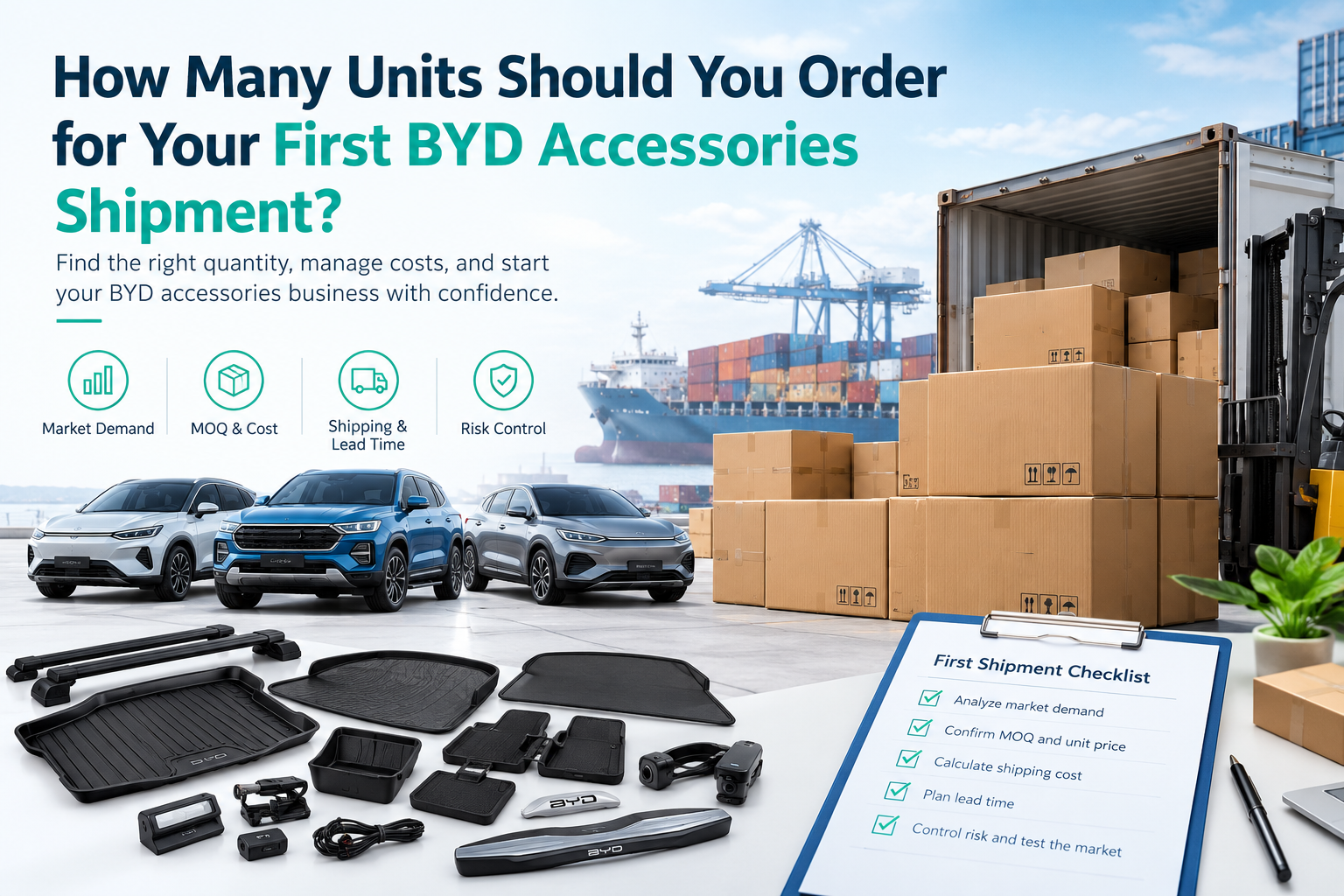
Starting a BYD accessories wholesale business can be an attractive opportunity for automotive distributors, retailers, and aftermarket businesses. However, one of the first questions new buyers face is simple: How many units should you order for your first BYD accessories shipment?
Order too many, and your capital may be tied up in slow-moving inventory. Order too few, and you may run out of popular products before your next shipment arrives. Choosing the right quantity is especially important when stocking accessories for multiple BYD models, vehicle configurations, and customer groups.
There is no single order quantity that works for every business. The right amount depends on your target market, sales channels, available budget, supplier minimum order quantity (MOQ), product range, and expected replenishment time.
For new buyers, a practical approach is to begin with a carefully selected range of accessories, test actual customer demand, and increase quantities as reliable sales data becomes available.
1. How Many Units Should You Order for Your First BYD Accessories Shipment?
For planning purposes, a small trial shipment might contain approximately 30–60 units, while a broader starter shipment might contain around 60–120 units across several product categories. These are illustrative planning ranges, not industry standards or guaranteed minimums. Your supplier's MOQ, product dimensions, and local demand may require a different quantity.
The key is to balance product variety with the number of units you can reasonably expect to sell.
Consider the following examples:
| Buyer Type |
Illustrative First Order |
Main Objective |
| Small online retailer |
30–60 units |
Test initial demand with limited inventory |
| New automotive accessories store |
60–120 units |
Offer a broader selection of products |
| Modification shop |
20–80 units |
Test selected products for existing customers |
| Established distributor |
Based on sales data and MOQ |
Stock proven products and serve repeat orders |
These quantities are examples rather than fixed recommendations. A shipment of 50 large exterior accessories can require more storage space and capital than 100 compact interior accessories.
Before deciding on a total quantity, separate your plan into individual product SKUs. One product category may contain several different SKUs because of variations in vehicle model, model year, configuration, or design.
For example, floor mats for the BYD ATTO 3 and BYD Dolphin should not automatically be treated as interchangeable inventory. Confirm the exact application for each product before placing your order.
2. Start With Your Target Market, Not the Supplier's Catalog
One common mistake is selecting products simply because a supplier offers a large catalog. A wide catalog does not automatically mean every item will sell well in your market.
Start by identifying the BYD vehicles your customers actually drive.
If you are selling in Australia or New Zealand, you may want to investigate demand for the BYD Shark 6 and its pickup accessories alongside passenger-EV products. In another market, models such as the BYD ATTO 3, Dolphin, Seal, or Sealion series may deserve more attention.
These are examples of models to investigate, not a universal demand ranking. Local vehicle registrations, customer inquiries, competitor listings, and your own sales records are better guides to your opening inventory.
Before choosing quantities, answer four questions:
-
Which BYD models are most common among your target customers?
-
Are your customers primarily interested in practical protection, interior organization, styling, or off-road upgrades?
-
Will you sell through an online store, a physical shop, a workshop, or a distribution network?
-
Which products are your customers already requesting?
The answers help you narrow down the products worth testing.
For example, a retailer serving everyday EV owners may begin with floor mats, trunk mats, sunshades, screen protectors, and storage accessories. A 4x4 modification business may prioritize pickup bed accessories, canopies, roof racks, running boards, and exterior protection products.
Your first shipment should reflect your customers' needs rather than attempt to cover every available BYD accessory.
3. Choose the Right Number of SKUs for Your First Order
SKU selection is just as important as the total number of units.
A new buyer may be tempted to purchase a few units of many different products to create a large catalog. While product variety can help attract customers, too many low-quantity SKUs can make inventory management difficult and increase the risk of slow-moving stock.
A more focused starter range is often easier to evaluate.
For example, consider building a small catalog around three categories.
Category A: Everyday Interior Accessories
Potential products include:
These products address practical customer needs and can complement one another in product bundles.
Category B: Exterior Protection Accessories
Potential products include:
These products can help you expand your range beyond interior accessories.
Category C: Model-Specific Styling and Upgrade Accessories
Depending on your customer base, you might consider spoilers, body styling products, roof racks, canopies, or other vehicle-specific upgrades.
For a first order, it may be sensible to test these products in smaller quantities when they are expensive, bulky, or designed for a narrower customer segment.
The objective is to create a balanced assortment without committing too much capital to products whose demand remains uncertain.
An illustrative 100-unit starter order
Suppose you want to test a range of BYD accessories with an initial shipment of approximately 100 units.
| Product Group |
Sample Quantity |
| Screen protectors and compact interior accessories |
30 |
| Sunshades and interior protection products |
20 |
| Floor mats and trunk liners |
15 |
| Mud flaps and door sill protectors |
15 |
| Window visors and other exterior accessories |
10 |
| Selected styling or higher-value products |
10 |
| Total |
100 |
This is an example of how a buyer might divide a planned order, not a recommended allocation for every market. You should adjust quantities according to selling prices, expected demand, individual SKU minimums, product value, and shipping costs.
The quantities also need to be assigned to exact product SKUs. If your 30 compact accessories include products for three different BYD models, you must confirm how those units will be divided among the models and configurations.
If your supplier requires a larger MOQ for a particular item, revise the assortment rather than blindly applying this example.
4. Calculate Your Initial Order Using Expected Sales
Once you have selected your products, estimate how many units you need to cover the first selling period.
A useful planning formula is:
Order Quantity = Expected Sales During the Coverage Period + Safety Stock − Available Stock − Confirmed Incoming Stock
For a new product without sales history, expected sales will be an estimate. Use customer inquiries, current orders, local competitor activity, and your planned marketing reach to develop a reasonable forecast.
For example, imagine that you estimate sales of eight units per week for a particular accessory. You want enough inventory for the first four weeks of selling, plus a buffer of four units.
Your calculation would be:
The initial calculated quantity would be 36 units.
However, this calculation assumes that the weekly sales estimate is reasonable. If the product is new and demand is uncertain, you may decide to place a smaller trial order and replenish after seeing the first sales results.
You also need to consider whether the supplier's MOQ makes the calculated quantity practical. If the MOQ is 50 units, ordering 36 may not be possible without an alternative arrangement.
This formula becomes more useful as you build a sales history and learn how quickly individual products move.
5. Check the MOQ Before Finalizing Your Purchase
MOQ, or minimum order quantity, is an important factor when buying BYD accessories wholesale from China.
Some suppliers may accept small quantities for selected products, while other items may have higher minimums because of production requirements, packaging arrangements, or customization.
Always confirm the MOQ for each SKU rather than assuming one quantity applies to the entire catalog.
Before placing an order, ask your supplier:
-
What is the MOQ for each product?
-
Can different BYD accessory SKUs be combined into one order?
-
Are sample orders available?
-
Are there quantity-based price differences?
-
Does customized packaging require a higher MOQ?
-
Can the supplier support repeat orders for the same products?
If the MOQ is higher than your forecasted demand, compare the cost of holding additional stock with the cost of arranging more frequent replenishment.
Do not choose a larger order solely because the unit price is lower. A discount can be outweighed by storage expenses, tied-up capital, shipping costs, or products that take too long to sell.
6. Calculate the Total Landed Cost, Not Just the Factory Price
The factory price is only one component of your initial purchasing cost.
For imported BYD accessories, your actual cost may include product prices, packaging, international freight, insurance where applicable, import duties, customs-related charges, and local delivery.
Your landed cost per unit can be estimated as:
Landed Cost per Unit = Total Import and Product Costs ÷ Total Units Received
Use the same cost basis when comparing suppliers or evaluating the profitability of different products.
For example, a compact screen protector may have a relatively low factory price and take up little shipping space. A large canopy or roof rack may involve more expensive packaging, greater shipping volume, and more complicated handling.
That does not make one category automatically more profitable than the other. It means they should be evaluated differently.
For your first shipment, review the following factors:
Purchase cost: How much capital will you need to pay for the goods?
Shipping efficiency: How much space and weight will the products occupy?
Selling price: What price can you realistically charge in your market?
Gross margin: How much remains after the product cost and other relevant direct costs?
Inventory turnover: How quickly do you expect to sell the quantity ordered?
A product with a low purchase price is not necessarily the best opening stock item. The better choice is one that combines realistic demand, acceptable margins, manageable logistics, and dependable product quality.
7. Be More Conservative With Expensive and Bulky Accessories
Not all BYD accessories should be ordered in the same quantity.
Compact items may be easier to store and allow you to test several product variations. Bulky exterior products may consume substantial storage space and increase freight costs.
Consider dividing products into three groups.
Higher-quantity candidates
Products may qualify for a larger trial allocation when they have clear customer demand, manageable costs, and efficient packaging.
Examples worth evaluating include screen protectors, compact organizers, and other smaller interior accessories.
Moderate-quantity candidates
Products such as floor mats, trunk liners, sunshades, mud flaps, and window visors may warrant a moderate initial allocation when local demand and model compatibility have been established.
The actual quantity should reflect the number of vehicles and configurations you intend to serve.
Lower-quantity candidates
Expensive styling upgrades, large roof racks, canopies, and specialized pickup accessories may be better suited to smaller initial quantities or customer-backed orders when demand remains uncertain.
Before ordering these products, confirm packaging dimensions, shipping costs, installation requirements, and the exact vehicle application.
For every category, a small order is useful only if the quantity is commercially practical and the supplier can fulfill it at an acceptable cost.
Compatibility mistakes can create avoidable returns, customer complaints, and unsold inventory.
A product may fit one BYD model but not another. Even products listed under the same model name may differ by production year, facelift, trim level, interior layout, or steering configuration.
Before confirming your first shipment, verify:
-
Exact BYD model and model year
-
Product dimensions and fitment
-
Left-hand-drive or right-hand-drive compatibility, where relevant
-
Material and finish
-
Installation method
-
Package contents
-
Product and carton dimensions
-
Quality inspection requirements
For electronic accessories, also confirm relevant electrical specifications and applicable requirements in your destination market.
For larger exterior upgrades, ask for clear product photos, installation references, and fitment confirmation before ordering bulk quantities.
When practical, test a sample before committing to a larger purchase. The cost of checking compatibility in advance may be much lower than the cost of handling unsuitable inventory later.
9. Plan Your Replenishment Before Your First Shipment Arrives
Your first order should not be planned in isolation. You should also consider how long it will take to reorder and receive products.
The replenishment cycle may include production, quality inspection, export preparation, international transportation, customs clearance, and local delivery. The actual timeline depends on the products, supplier, shipment method, and destination.
Ask your supplier for an estimated lead time and clarify which stages are included.
Then set a reorder point for products once you have enough sales data.
A basic reorder-point formula is:
Reorder Point = Average Daily Sales × Replenishment Lead Time in Days + Safety Stock
For example, if you sell two units per day and the expected replenishment lead time is 20 days, you would need to consider 40 units of expected lead-time demand before adding your safety stock.
This is an illustrative calculation, not a forecast for a specific BYD accessory. Actual demand, delivery variability, and your business's tolerance for stockouts should determine the final reorder point.
The important principle is to begin monitoring sales and inventory from the first day. Do not wait until a popular product is completely out of stock before contacting your supplier.
10. Common Mistakes to Avoid When Ordering BYD Accessories Wholesale
Ordering Too Many Products at Once
A large opening catalog can create unnecessary inventory risk. Start with products that have a clear target customer and a realistic sales opportunity.
Focusing Only on the Lowest Unit Price
The lowest factory price does not guarantee the lowest total cost or the best profit margin. Include transportation, import expenses, packaging, and expected selling costs in your evaluation.
Ignoring Product Compatibility
A product that does not fit the customer's exact BYD model can result in returns and damage your reputation. Confirm compatibility before ordering.
Underestimating Shipping Costs
Large and heavy products can affect the economics of a small shipment. Request packaging dimensions and compare shipping options before confirming quantities.
Failing to Review Sales Data
A successful first order is not simply one that arrives at a low price. It should help you understand what customers buy, which products are slow-moving, and what you should reorder.
After the first sales cycle, review units sold, gross margin, remaining inventory, customer feedback, and returns by SKU. Use that information to adjust your next order.
11. How Econg Auto Can Help You Plan Your First BYD Accessories Order
For overseas distributors and retailers, working with an appropriate supplier can simplify product selection and initial purchasing.
Econg Auto supplies automotive accessories for BYD, Tesla, XPENG, and other Chinese EV brands. Its product range includes interior accessories, exterior accessories, storage solutions, protective products, and selected pickup and off-road upgrades.
For buyers preparing their first BYD accessories shipment, a practical sourcing process starts with the target market and vehicle models, then moves through product selection, SKU-level MOQ confirmation, sample evaluation where appropriate, quotation review, packaging checks, and shipment planning.
Before confirming your purchase, prepare a list of the models you serve and the accessories you want to test. Share your estimated quantities and ask your supplier to clarify the MOQ, product compatibility, lead time, packaging, and shipping arrangements.
You do not need to purchase an extensive catalog immediately. A focused starting range can give you a clearer picture of your customers' preferences and help you make better inventory decisions over time.
Contact Econg Auto to discuss wholesale BYD accessories and develop a product selection suited to your target market, business model, and initial purchasing budget.
Final Thoughts
So, how many units should you order for your first BYD accessories shipment?
The answer depends on your expected sales, product range, available budget, supplier MOQ, and replenishment time. A small trial shipment may be suitable for a new retailer, while an established distributor may need a larger quantity to serve existing customers.
Instead of trying to stock every available product, select a manageable range of BYD accessories, calculate demand at the SKU level, confirm compatibility, and evaluate your total landed costs.
Most importantly, use your first shipment to collect real sales data. Reorder products that demonstrate demand, adjust quantities based on actual performance, and expand your range as your business develops.
The goal of your first shipment is not simply to buy more units. It is to build a repeatable, profitable inventory strategy for your BYD accessories business.